Most brands of candle select the wrong glass.
So, after years working in candle jar factories, fragrance labs and export packaging audits, I have seen this same trend over and over again; buyers will debate the colour of the vessel, the texture of the label, the wax finish, and the story of the fragrance for weeks, but very few ask what will happen if the candle is subjected to repeated thermal cycling at 180°C with uneven flame distribution and cooling stress in an air-conditioned retail environment. Then there are cracks.After that, there are cracks. Next, the customer grievances come out on the internet. Then all of a sudden material science is all the rage.
In 2024 and 2025, the debate on borosilicate vs soda-lime glass came to a head as high-end candle manufacturers came under greater scrutiny for fire safety and thermal stability. Candle-related consumer safety issues from container failures persist including overheating, shattering glass, and surface instability, according to the U.S. Consumer Product Safety Commission. This is not something that the industry would want discussed in public as it injures more than products. They damage trust. In the luxury fragrance world, trust is eroded very rapidly.
The bad news: A significant number of candle holders are still chosen primarily for their cost efficiency and hardly at all for thermal performance. Soda-lime glass is used in mass production of candles since it can be moulded easily and cheaply, is available world wide in very large quantities. However, low cost does not translate to good performance when it comes to heat stress. As scented candle formulations began to increase in fragrance content, begin using wooden wicks, and begin incorporating multi-wick systems and longer burn times, the shortcomings of the lower-grade soda-lime systems became more apparent.
1. The Real Differences Between Borosilicate and Soda-Lime Glass
The chemistry of borosilicate glass versus soda lime glass is the starting point for differences. Soda-lime glass is primarily composed of silica (SiO₂), sodium oxide (Na₂O), and calcium oxide (CaO), whereas borosilicate glass contains boron trioxide (B₂O₃) which greatly alters the thermal expansion. That one change changes the way a glass reacts to fast temperature changes.
Thermal expansion is all-important in the making of candles.
A pot will not split when heated. It cracks due to the different parts of the glass expanding differently under the influence of the temperature. Candles jars have withstood direct exposure to flames in laboratory tests but then failed minutes later when the candle is placed on a cold marble countertop. This is the type of behaviour of soda-lime glass which is typical of thermal shock. The outer surface cools more rapidly than the inner structure and the resulting stresses are compounded until they suddenly propagate as micro fractures through the container.
The coefficient of thermal expansion of borosilicate is much lower and thus it acts differently. The value for soda-lime glass is about 9 × 10⁻⁶/K, and the value for borosilicate is near 3.3 × 10⁻⁶/K. Borosilicate candle jars have a much greater resistance to rapid temperature changes throughout their burn cycles, filling operations and exposure in transit.
However, it comes with a catch.
Actually, several.

2. Why Soda-Lime Glass Still Dominates Candle Production
Why is soda-lime glass so prevalent in the world candle industry even though borosilicate is better to withstand heat?
Simple answer. Cost pressure.
The raw materials are readily available, furnace temperatures are best matched for fast production, and decorative processing is simpler on a large scale and thus is much cheaper for soda lime glass. That’s more important to large retailers that sell seasonal candles at aggressive margins than extreme thermal performance.
In fact, there are a lot of candle brands that don’t require borosilicate.
That section is disregarded on the internet.
Wax fill ratios, wick sizing, wall geometry and thick base distribution of the candle jar can be all correct for standard home use and it may operate ideally. It’s not about soda-lime. The issue is, it’s poorly engineered and cost cutting is impossible.
I’ve witnessed factories cutting as little as 1.5mm to save the weight of freight and the cost of raw materials in shipping containers. This small decrease made a huge difference in the distribution of thermal stress for the burn testing. However, after a 3-hour continuous burn, suddenly jars started to fail. Well, nobody did say that the redesign was made public, anyway. But inside everyone knew what had occurred.
Optimization that is cheap, causes recall that is expensive.
3. Borosilicate Candle Jars Heat Resistance Is Real — But Overhyped
I read an interesting type of packaging marketing where suppliers tout borosilicate as almost indestructible. That is nonsense.
Yes, borosilicate candle jars has significantly improved heat resistance when compared to the traditional soda-lime system. Under controlled conditions, laboratory grade borosilicate can withstand temperature fluctuations above 150°C without being broken. For this reason, borosilicate is often used in scientific glassware, industrial piping and high-temperature laboratory equipment.
Kerzengläser, however, are not beakers!
The use of real candles includes uneven flame patterns, burning the fragrance oil, carbon buildup, wicks that are off-center, consumer misuse and inconsistent room air flow. If the candle architecture is poorly designed, even borosilicate may not work.
This is where luxury brands often fall down. They believe that upgrading glass material equals to good product engineering. It does not. No matter what the material of the vessel is, the triple-wick candle with the unstable flame and overloaded fragrance oil can still create the dangerous hotspot concentration.
Material matters. Design matters more.
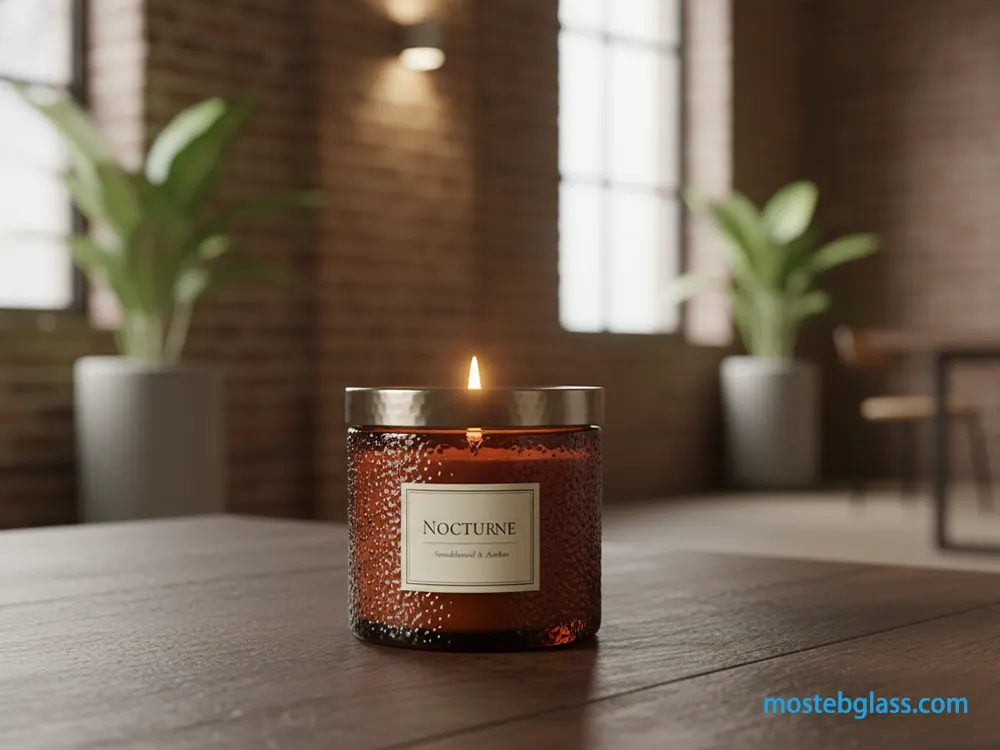
4. Which Glass Is Safer for Candles?
This question is a seemingly easy one. It is not.
The safer option is very much relative to the burn profile, size of the candle, the perfume strength, and how it is likely to be used. High quality soda-lime glass can be entirely safe if designed properly and used in the appropriate conditions for small-to-medium sized single-wick candles under controlled indoor conditions. If you are using large luxury candles or are using multi-wick candles, or if you need a vessel to withstand extreme temperature fluctuations, borosilicate typically offers a greater safety margin.
Researchers at MIT, via the materials science resources, found that there is a close relationship between thermal shock resistance and expansion coefficient and internal stress management in brittle materials. That is a direct principle that relates to candle containers because the required heating and cooling cycles over time makes the glass structures vulnerable.
When I see suppliers touting super skinny soda-lime candle jars for big, fancy candles, I start to have doubts. While it might be stylish to post on Instagram, that’s not science. Repeat exposure to temperatures above local tolerance levels will make failure ever more likely.
And consumers notice.
Fast.
5. Borosilicate vs Soda-Lime for Scented Candles
Scented candles create additional pressure on glass performance because fragrance oils alter combustion characteristics. Heavier fragrance loads often increase soot formation, uneven flame movement, and internal heat accumulation near the upper vessel wall.
That is why borosilicate vs soda-lime for scented candles has become a serious sourcing discussion rather than a niche technical topic.
| Faktor | Borosilikatglas | Soda-Kalk-Glas |
| Beständigkeit gegen Temperaturschocks | Exzellent | Mäßig |
| Production Cost | Höher | Untere |
| Visual Clarity | Very high | Hoch |
| Heat Expansion Rate | Niedrig | Höher |
| Manufacturing Scalability | More limited | Extremely scalable |
| Bester Anwendungsfall | Premium luxury candles | Mass-market candles |
| Resistance to Rapid Cooling | Stark | More vulnerable |
| Decorative Flexibility | Mäßig | Exzellent |
The irony is that some high-priced brands are now selling borosilicate just so it’s “scientific” and “luxurious”, even if a candle doesn’t really need it. Meanwhile, some established manufacturers quietly make the best possible soda-lime systems they know how to make due to the fact that they understand wall balance, annealing quality, and understanding the calibration of the wicks much better than the other people that charge two times the price.
Materials are never the only answer.
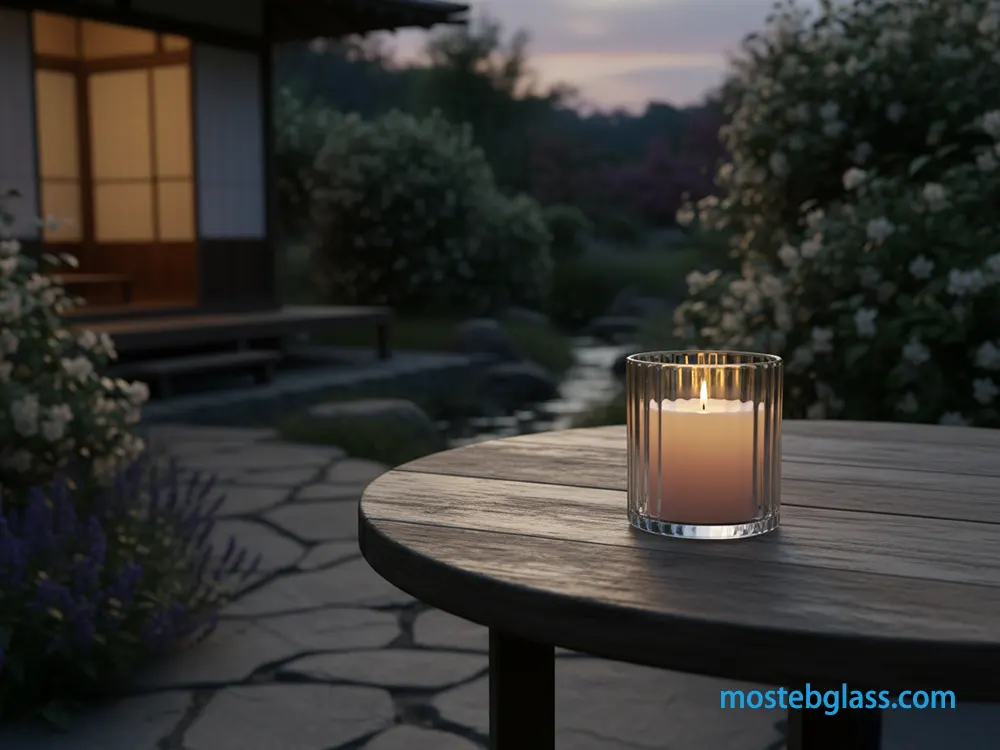
6. How to Choose Glass Material for Candle Jars
The majority of buyers think of candle jars from the back to the front. First they ask about appearance and price and then “safe” comes in later. Highly competent manufacturers do just the opposite.
When I’m considering the selection of glass to be used for candle containers, I remember the following five factors to consider first:
- Continuous burn duration
- Wick configuration
- Fragrance concentration percentage
- Vessel diameter
- Distribution climate conditions
A candle that is sold in Scandinavia will act differently from the one which is shipped to Arizona warehouses during July. Transportation conditions matter. Storage temperatures matter. Even the lighting in a retail store can have a long-term effect on the stress in a lower grade ship.
One of those not-so-fun facts that is not openly discussed in the industry is that in many instances, glass failures that are attributed to “material defects” are caused by inadequate annealing control in the production process. Residual stress remains in the vessel even after the annealing due to improper annealing. Those hidden stress points start to act as fracture initiators when repeated burn cycles start.
Yes, the composition of the glass does make a difference. However, discipline in manufacturing is equally important.
7. Advantages of Borosilicate Candle Jars
Borosilicate candle jars have properties of low thermal expansion, high thermal shock resistance, high clarity retention under high temperature, and stability during repeated burning. Their properties make them particularly suited to luxury scented candles, multi-wicks and high temperature uses where soda lime containers may be subject to increased stress fatigue over time.
However, I don’t think that borosilicate is necessarily going to replace soda-lime industry-wide. The economics just don’t make sense on a large scale. I do have one thing to say, though: brands that have a retail price more expensive than $45 to $60 should probably take glass choice off the list of flair features. With that much money, consumers demand both looks and engineering reliability.
But more and more, regulators do as well.