Custom packaging sounds simple.
It rarely is.
A home fragrance company can come with a sketch, a reference bottle, a Pantone colour and a desired capacity of 100ml or 200ml. The manufacturer then needs to convert this idea into a glass body that can be formed, annealed, decorated, filled, sealed, packaged and shipped in commercial quantities.
That is where the difference between a catalogue reseller and a capable diffuser bottle manufacturer becomes obvious.
A supplier may offer 50ml, 100ml, 150ml, 200ml, or 250ml bottles. That does not automatically mean it can reproduce your shape, neck finish, color, decoration, and closure as one consistent system.
And this is the part buyers often underestimate.
The bottle is not an isolated object. It is a packaging system.
1. What Can a Diffuser Bottle Manufacturer Actually Customize?
For B2B buyers, customization normally falls into several layers: bottle geometry, capacity, glass appearance, neck finish, surface decoration, closure components, and secondary packaging.
Some manufacturers work mainly with existing moulds. Others can develop private moulds for proprietary silhouettes.
The commercial difference can be substantial.
Current market examples show how broad the range can be. Some suppliers list stock and custom garrafas difusoras from approximately 35ml to 330ml, while other manufacturers offer 50ml–500ml collections and custom shapes. Custom MOQs also vary dramatically: published examples range from around 3,000 units to 10,000 or even 30,000 units, depending on the manufacturer and development method.
So, “Can you customize it?” is the wrong first question.
Ask instead:
Which part can you customize, and at what production volume?
2. Bottle Shape Is Usually the Most Visible Custom Element
For home fragrance brands, the silhouette often carries more branding value than the label.
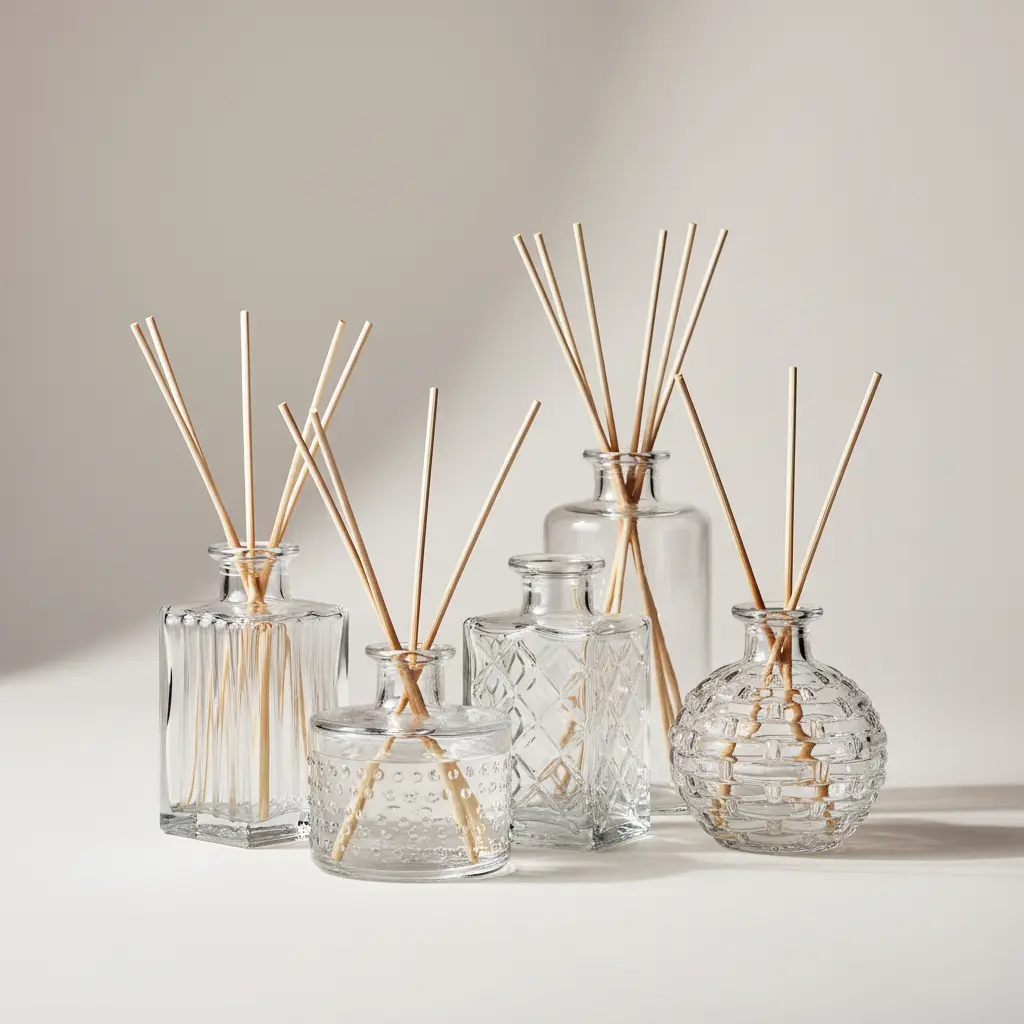
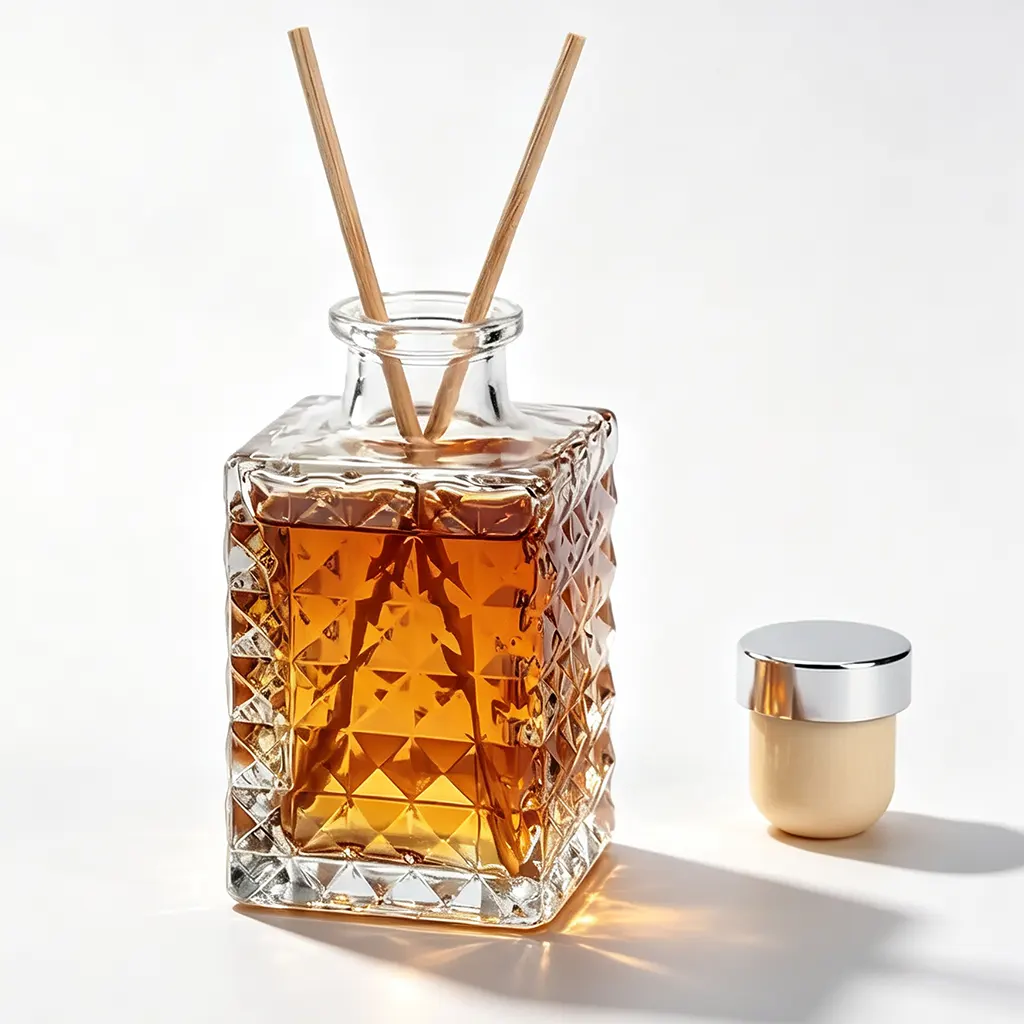
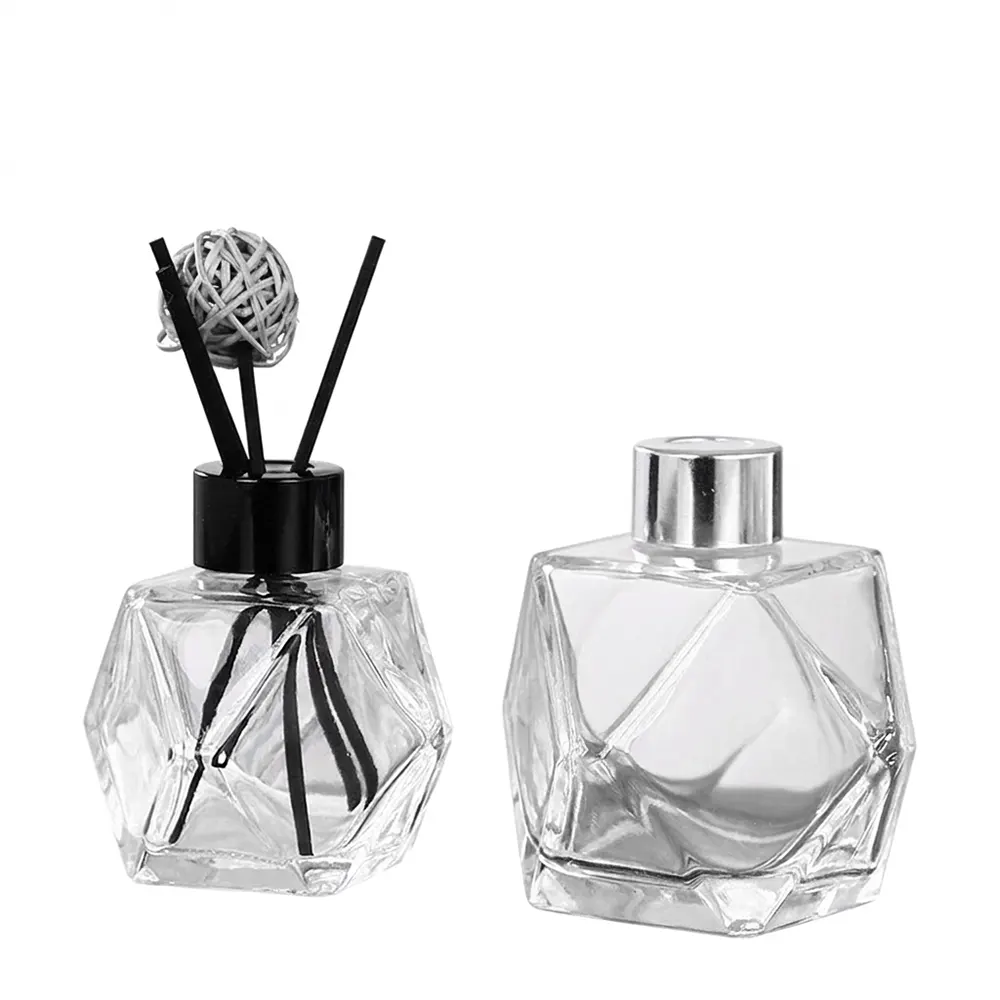
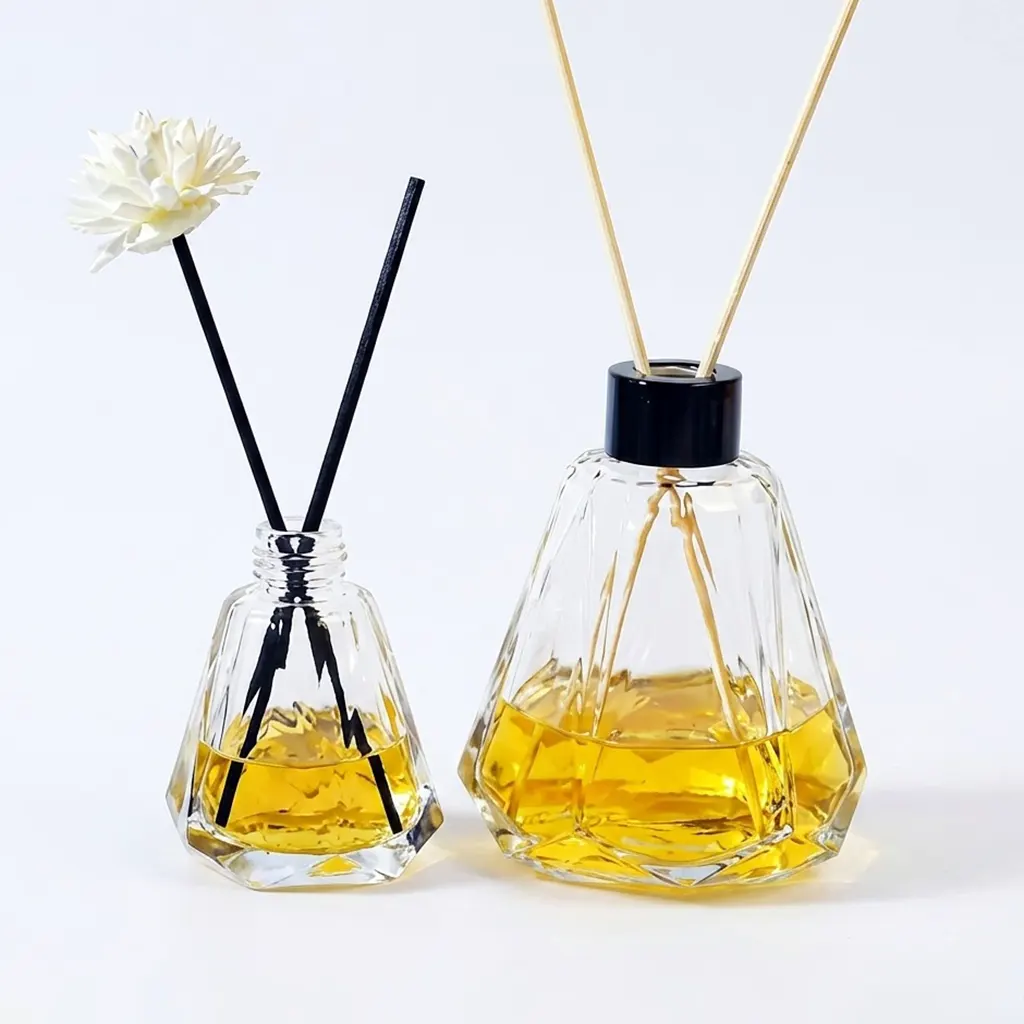
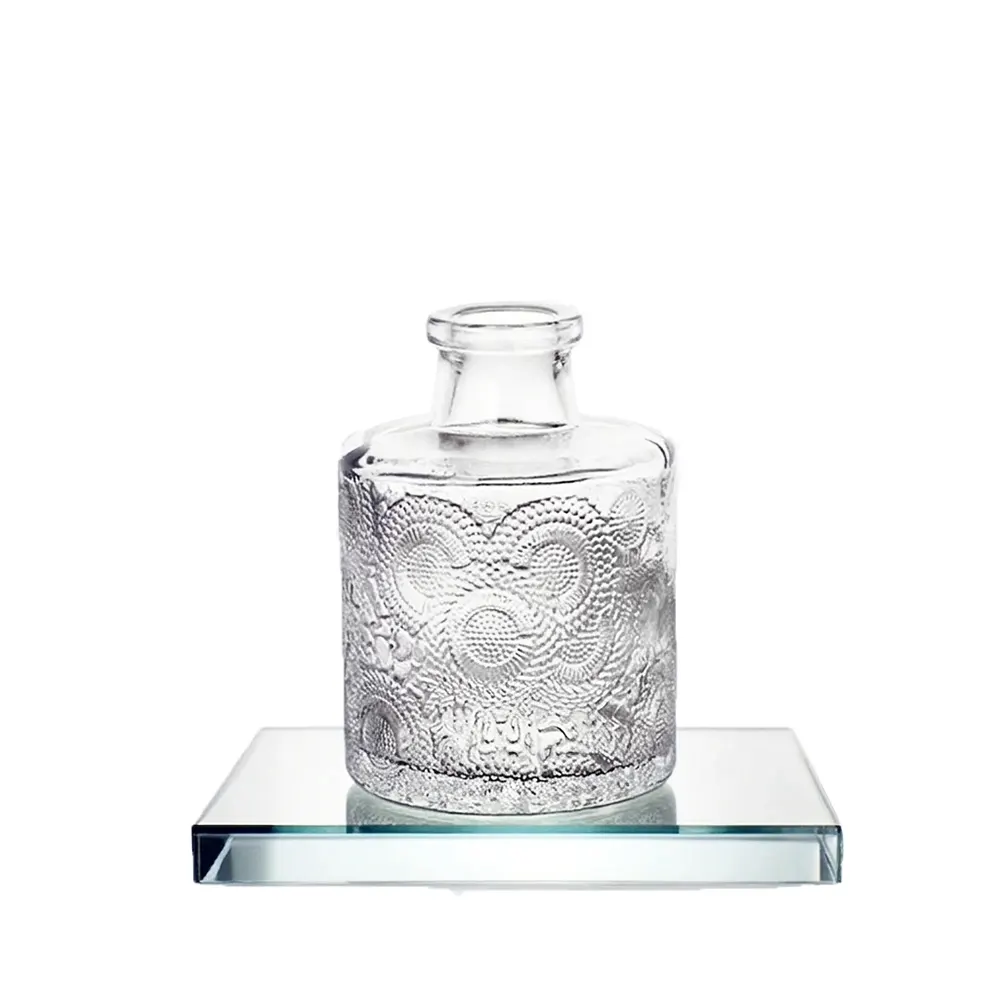
Round. Square. Cylinder. Dome. Apothecary. Fluted. Heavy-base. Sculptural.
A distinctive glass profile can make a standard fragrance formula look like an entirely different retail product.
A manufacturer can develop the body through an existing mould, modify an available mould, or create a new mould. The economics change at every step.
Existing moulds generally reduce development time and tooling expense. The engineering, the mould making, sampling, dimensional confirmation and production validation of a completely proprietary bottle.
One supplier currently provides square, round, domed, fluted and embossed diffuser bodies ranging from 35ml to 330ml capacity, while another offers a range of capacities from 50ml to 500ml with all of them being in a single matte round series.
That matters when planning a product family.
A 100ml hero SKU and a 200ml refill SKU should ideally look related without forcing the manufacturer to create completely unrelated production structures.
3. Neck Finish Is a Technical Decision, Not a Decoration
This is where many packaging projects become unnecessarily complicated.
The neck determines how the bottle connects with the closure, collar, stopper, plug, or diffuser accessory. A visually attractive bottle with an incompatible closure is not a finished packaging solution.
For threaded diffuser packaging, suppliers commonly specify neck systems such as 24/410 or 28/410. Cork-finish designs use a different mechanical interface.
The dimensions must match.
The tolerance must match.
The actual component must be tested.
A current diffuser-packaging supplier explicitly warns buyers to confirm that the bottle and cap share the same neck-finish specifications before ordering components separately.
This is why a competent B2B glass packaging supplier should discuss the complete assembly rather than quote the glass body alone.
4. Customization Extends Beyond the Glass
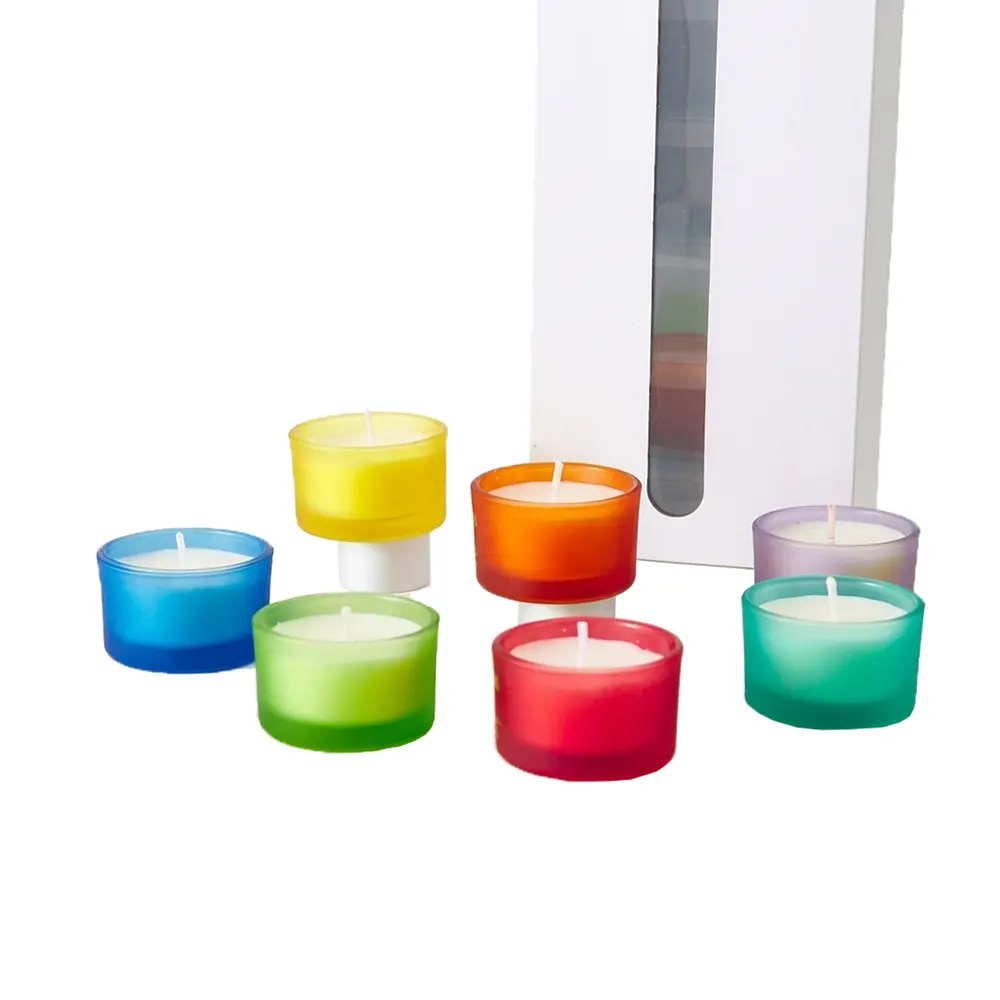
A bottle can be clear, amber, smoky, frosted, coated, tinted, or decorated.
The logo can be printed.
Or hot stamped.
Or etched.
Or embossed.
Or applied through a label.
For premium home fragrance brands, the finishing process often becomes part of the product architecture.
For example, current supplier offerings include frosting, spray coating, gradient finishes, silk-screen printing, hot stamping, UV printing, electroplating, and customized caps.
But every decoration method creates its own production constraints.
A metallic finish may require a different surface-preparation process from screen printing. Frosting changes the tactile and optical appearance of the glass. Coatings need to be evaluated against the intended formulation and handling conditions.
A sample that looks perfect after seven days is not proof that the same finish will remain stable after months of contact with fragrance oils.
That is why I would never approve a custom diffuser bottle based solely on a photograph.

5. The Manufacturer Should Match the Bottle With the Fragrance System
Here is the uncomfortable truth: the most beautiful diffuser bottle can still be a poor packaging choice.
The liquid matters.
The closure matters.
The reeds matter.
The neck opening matters.
Even the internal geometry can matter because the bottle is part of a dispensing and evaporation system.
Reed diffuser packaging commonly combines the glass vessel with a collar, plug, cap, and rattan or fiber reeds. Some suppliers therefore quote these components together rather than treating the bottle as a standalone SKU.
This is particularly important for brands selling different fragrance bases.
A formulation with one carrier system may behave differently from another. The supplier should therefore test the complete packaging combination rather than assuming that one bottle-and-closure configuration will perform identically across every formula.
6. Customization Comparison for B2B Buyers
| Customization Level | Typical Approach | Tooling Impact | Best Use |
| Stock bottle | Existing mould and standard finish | None or minimal | New brands, testing |
| Decorated stock bottle | Existing bottle + color/printing | Baixo | Coleções de marca própria |
| Modified design | Existing platform adapted to requirements | Médio | Distinctive brand packaging |
| Custom mould | New proprietary bottle geometry | Alto | Premium or signature products |
| Full packaging system | Bottle + closure + collar + reeds + decoration | Highest | Large-scale branded collections |
The commercial lesson is straightforward: do not pay for a new mould when an existing platform can achieve the required market differentiation.
But do not force an existing bottle into a brand concept that clearly requires proprietary geometry either.
Cheap tooling can become expensive branding.
7. MOQ Changes the Meaning of “Custom”
MOQ is one of the least glamorous parts of packaging procurement.
It is also one of the numbers that can destroy a project.
Published supplier examples show major differences. One manufacturer lists a 3,000-piece MOQ for customized matte diffuser bottles, while another lists 5,000–10,000 units for custom diffuser products. A separate manufacturer publishes 30,000 units as its MOQ for custom reed diffuser bottles.
That does not mean one number is universally “normal.”
It means buyers must ask what the MOQ actually covers.
Is it:
- per design?
- per color?
- per capacity?
- per mould?
- per decoration?
- per production run?
- or the total order?
For a brand launching five scents, 10,000 pieces per design can turn a seemingly reasonable quotation into 50,000 units of inventory.
That is not a packaging problem.
It is a procurement problem.
8. Existing Moulds Can Be a Strategic Shortcut
Suppose your team wants a 100ml square diffuser bottle with a heavier base, frosted finish, black collar, and custom logo.
The manufacturer may already have a similar square body.
Instead of commissioning a completely new mould, the supplier can evaluate whether the existing geometry can satisfy the capacity, stability, label area, neck dimensions, and aesthetic requirements.
That conversation should happen before tooling.
Ask the manufacturer for:
- Existing mould photographs
- Capacity and dimensional drawings
- Neck-finish specifications
- Available colors
- Decoration options
- MOQ by customization method
- Sample lead time
- Tooling cost if required
- Production tolerance
- Packaging and shipping configuration
This turns “custom packaging” into an engineering discussion.
That is exactly what a professional B2B sourcing process should look like.
9. Decoration Should Be Tested With the Actual Packaging
A bottle can look perfect and still fail commercially.
A professional QC process should examine dimensions, neck finish, bottle weight, visual defects, color consistency, base stability, decoration, assembly, leakage, and packaging integrity.
For custom production, dimensional consistency becomes particularly important.
Why?
Because a small change in the neck can affect closure fit. A change in the base can affect stability. A variation in decoration can affect the appearance of an entire retail batch.
For a high-volume order, consistency is often more valuable than having one exceptionally attractive sample.
The sample represents possibility.
The production batch represents reality.
10. A Practical Supplier Comparison
| Fator | Stock Bottle Supplier | Custom-Capable Manufacturer |
| Existing bottle range | Usually strong | Forte |
| Custom silhouette | Limitado | Available |
| Private mould development | Usually limited | Available |
| Neck customization | Limitado | More flexible |
| Decoração | Opções padrão | Multiple processes |
| Closure matching | May be outsourced | Can be integrated |
| MOQ flexibility | Often higher for custom work | Depends on production model |
| Engineering support | Básico | CAD, mould, sampling and production support |
| Best fit | Fast standard launches | Branded B2B packaging projects |
The important distinction is not whether a company calls itself a manufacturer.
It is whether it can demonstrate control over the parts that determine your final packaging.
11. What Should Buyers Request Before Ordering?
I recommend requesting a technical quotation rather than simply asking:
“Price for 10,000 diffuser bottles?”
That question is too vague.
Send the manufacturer:
- bottle capacity
- reference drawings or photos
- target dimensions
- glass color
- acabamento de superfície
- neck finish
- closure requirements
- reed type
- fragrance formulation information where relevant
- logo artwork
- target quantity
- destination market
- expected annual volume
Then request a sample.
Then test it.
Then approve the production specification.
A serious best diffuser bottle manufacturer for custom designs should be able to explain which requirements are technically achievable, which require tooling, and which may increase MOQ or lead time.
That honesty is worth more than a suspiciously cheap quotation.
12. What Does Custom Diffuser Bottle Packaging Really Include?
For a B2B project, customization can extend across the complete package:
Glass body → neck → collar → stopper → cap → reeds → decoration → retail packaging → export packaging
That sequence matters.
If the glass supplier provides only the bottle but another supplier provides the collar, another supplies the cap, and another supplies the reeds, responsibility becomes fragmented.
When something leaks, who owns the problem?
When the cap does not fit, who pays?
When the decoration fails after contact with fragrance oil, who investigates?
This is why integrated sourcing can reduce coordination risk even when the unit price is not the absolute lowest.
13. FAQ
A manufacturer of diffuser bottles customizes?
A diffuser bottle manufacturer can design the bottle in various shapes, provide a variety of bottle sizes, glass colors, neck finishes, surface decorations, bottle closures, and secondary packaging. The supplier can also, depending on production capacity, be able to create their own moulds and integrate collars, plugs, caps and reeds into one overall home-fragrance packaging system.
How do you 'personalise' glass diffuser bottles?
The development of custom glass diffuser bottles normally starts with the choice of the bottle platform or the production of a new mould and then proceeds with the bottle capacity, size, neck finish, appearance of the glass, decoration, closing and packaging. Before buying for bulk production, the buyer should test samples, and check the entire bottle and closure system.
What is the typical MOQ in custom reed diffuser bottles?
The minimum order (MOQ) of a custom reed diffuser bottle is not an universal because it depends on the type of tooling, the geometry of the bottle, decoration, colour and production scale. The number of pieces for some customized stock designs runs about 3,000, while for larger custom projects, the numbers can be as high as 10,000 or 30,000.
Is the shape of the diffuser bottle adjustable?
Yes, manufacturers who have the mould development expertise can produce unique bottle moulds, such as square bottles, round bottles, dome bottles, fluted bottles, embossed bottles and others shaped for various brands. A new shape always brings in new tooling, sampling, dimensional checks, and minimum order quantity, however.
Should the diffuser bottle and cap be from the same manufacturer?
If using one supplier for the bottle and compatible closure, it can help to make dimension control, assembly testing, and responsibility for fitment easier. Buyers, however, can obtain the components on their own if they have confirmed the precise dimensions and tolerances of the neck-finish, the sealing method, and the compatibility of the entire packaging system.
What should be taken into consideration when selecting a diffuser bottle manufacturer?
A home fragrance manufacturer should consider capability to manufacture, existing moulds, customization options, neck-finish control, decoration, MOQ, sampling, QC procedure, component matching, packaging, lead time and documentation. While the lowest quoted price may be one of the primary considerations, packaging failures can cost much more than a higher initial quotation.